When you choose aluminium from Hydro, it's strong, light, durable and climate efficient, making you part of a smarter and more sustainable future. Our climate strategy is to cut our CO2 emissions 30% by 2030. Our aluminium can help you meet your goals, too.
Energy
Hydro has been at the forefront of the energy transition since 1905, transforming industries and societies with renewable energy. Today, we are pioneering the green aluminium transition through renewables and new energy solutions.
Sustainability
We want to contribute to the just and green transition through responsible production, creating circular solutions and delivering net-zero aluminium by 2050 or earlier.
Careers
At Hydro, we put our people at the center of everything we do. By supporting our employees’ growth professionally and personally, we are fostering a community of colleagues who are united in the shared purpose of solving our industries’ most pressing challenges.
Investors
With more than a century of industrial experience, we are enabling the green transition through innovation, technological advances, and a strong commercial mindset.
Media
Working on a story about aluminium? Press releases, photos, stories, facts and figures – you will find everything you need here.
About Hydro
Hydro is a leading aluminium and renewable energy company that builds businesses and partnerships for a more sustainable future. We have 32,000 employees in more than 140 locations and 42 countries.
Data centers consume enormous amounts of energy, and most of it eventually turns into heat. How that heat gets managed determines whether a facility runs reliably or not. Aluminium conduct heat well and weighs far less than the alternatives, and through extrusion, it can be shaped into exactly the cross-sections that cooling and structural applications demand.
The global data center industry is expanding at an unprecedented pace, driven mostly by cloud computing, and more recently by the surge in processing power needed to train and run AI systems. Europe alone is expected to see over €170 billion in data center investment between 2026 and 2031.
More data centers means more demand for aluminium. Every megawatt of capacity requires substantial amounts of metal, mostly in power distribution and cooling systems. Extruded aluminium profiles are suitable for components throughout an entire facility, from the structure of the building to the server rack.
Where aluminium extrusions are used
Thermal management
Heat is one of the biggest operational challenges in any data center. Servers and networking equipment generate enormous amounts of thermal energy, and keeping temperatures within safe operating ranges is critical.
Aluminium's high thermal conductivity makes it a natural fit for heat sinks, heat exchangers and cooling fins. Extruded profiles can be designed with complex fin geometries that maximize surface area for heat dissipation, whether the system relies on passive convection, forced air or liquid cooling.
Aisle containment systems
Data center design relies on separating hot and cold air streams to prevent them from mixing. Aisle containment systems can use extruded aluminium frames for ceiling panels, vertical partitions, containment walls and doors. Aluminium's modular nature makes these systems easy to reconfigure as rack layouts change over time.
Busbars and power distribution
Aluminium busbars can serve as conductors in data center busway and upstream power distribution systems.
While aluminium has lower electrical conductivity than other materials like copper, it offers significant advantages in weight and cost. For large-scale power distribution where space is less constrained, aluminium busbars are an increasingly common choice.
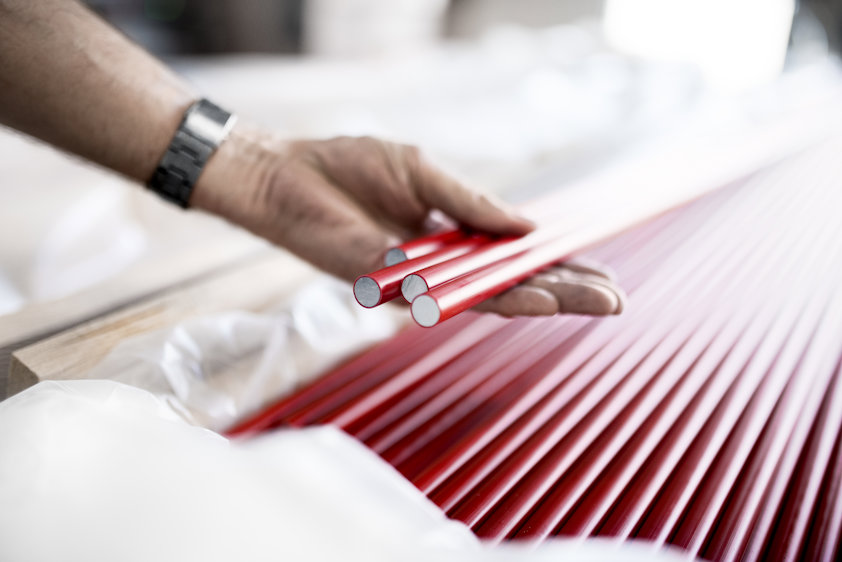
At Hydro, we can supply extruded busbars and tubes for electrical applications, and this experience transfers directly to data center power systems.
Busbars
Interior and exterior building applications
Data center interiors are full of components that suit aluminium extrusions. Cable management systems, equipment enclosures, mounting frames, modular wall systems, partition framing and ceiling grid structures all benefit from aluminium's strength-to-weight ratio. Lighter components reduce loads on raised floors, improve handling and speed up installation. And because data center layouts change as technology evolves, aluminium's modular nature makes reconfiguration straightforward.
On the outside, ventilated aluminium wall cladding conceals industrial cooling units while allowing the airflow a facility needs. These systems can be powder-coated in any colour to meet architectural and planning requirements.
A more sustainable material choice
Across this industry, there is growing pressure to reduce the environmental footprint of their facilities, and that extends beyond energy consumption to the materials used in construction. Aluminium is 100% recyclable without any loss in properties, and recycling it requires only around 5% of the energy needed to produce primary metal. That makes it one of the most circular construction materials available.
Why choose aluminium for data center applications
Thermal performance: Aluminium conducts heat efficiently, making it ideal for heat sinks, cooling systems and thermal management components.
Lightweight: At roughly one-third the weight of steel or copper, aluminium reduces structural loads and simplifies handling and installation.
Cost-benefits: Aluminium offers a lower material cost compared to copper, which matters when volumes are high.
Design flexibility: Extruded profiles can combine multiple functions into a single cross-section, replacing what would otherwise be several separate components.
Corrosion resistant: Aluminium naturally resists corrosion, extending component lifespan and reducing maintenance requirements. Recyclable: Aluminium is 100% recyclable without loss of properties.
Alloys for data center applications
We supply extruded profiles in a range of alloys suited for data center applications. The 6063 series is commonly used for heat sinks and architectural profiles, while 6061 offers higher strength for structural components. For a full overview of available alloys for extruded profiles, visit our alloys pages.